


Understanding Transition Metal Complexes:Back-bonding with CO and NO
1. Rygbinding: Dette er den vigtigste drivkraft. Transition metals in these low oxidation states have a high density of electrons in their d-orbitals. Ligands like CO and NO possess empty antibonding π* orbitals.
* The filled d-orbitals of the metal can donate electron density into the empty π* orbitals of the ligand, forming a π-backbond .
* This back-bonding interaction strengthens the metal-ligand bond significantly.
2. Synergisk binding: This refers to the combined effect of σ-donation and π-backbonding.
* The ligand (CO or NO) donates electron density to the metal through a σ-bond.
* This donation makes the metal more electron-rich, facilitating the back-donation process.
3. Stabilitet: π-backbonding-interaktionen fører til:
* Øget elektrontæthed: The metal center gains electron density, leading to increased stability.
* Svækkede ligandbindinger: The back-donation into the π* orbitals weakens the C-O and N-O bonds in CO and NO, respectively, increasing their reactivity.
4. Elektronisk konfiguration: Transition metals in low oxidation states often have a d 8 eller d 10 electronic configuration, which favors complex formation with strong π-acceptor ligands like CO and NO.
5. Ligandegenskaber: CO og NO er begge stærke π-acceptorligander. Their ability to accept electron density from the metal is crucial for the back-bonding interaction.
Eksempel:
* I nikkelcarbonyl (Ni(CO)4 ), er nikkelatomet i en nuloxidationstilstand.
* CO-liganderne donerer elektroner til nikkel gennem σ-bindinger og modtager tilbagedonation fra nikkelens fyldte d-orbitaler til deres π*-antibindings-orbitaler.
* This strong back-bonding makes nickel carbonyl a very stable compound.
Konklusion:
Kombinationen af tilbagebinding, synergisk binding og de gunstige elektroniske konfigurationer af overgangsmetaller i lave oxidationstilstande gør kompleksdannelse med ligander som CO og NO yderst favoriseret. These complexes are often very stable due to the strong metal-ligand bonds formed through back-bonding.
 Varme artikler
-
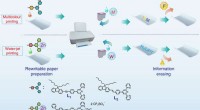 Specialpapir kan slettes og udskrives på flere gangeSkematisk illustration af flerfarve- og vandtryk. Kemiske strukturer af L 1 , L2 og L3, og udskrivnings- og sletteprocesserne for det konstruerede genskrivbare papir. Kredit: Naturkommunikation (2017
 -
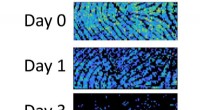 Rester i fingeraftryk indeholder spor af deres alderNiveauer af umættet triacylglycerol falder i fingeraftryk fra et individ fra dag 0 (øverst) til dag 1 (midten) og dag 3 (nederst). Kredit:Tilpasset fra Analytisk kemi 2020, DOI:10.1021/acs.analchem.
 -
 Kemiker viser, at intermolekylære interaktioner kan opnå hidtil ukendte dimensionerKredit:The Journal of Physical Chemistry Letters Intermolekylære interaktioner er de kræfter, der vedrører molekyler. Generelt strækker disse interaktioner sig næppe ud over molekylernes grænser.
 -
 Forskere opdager nye ikke-klæbende gelerBillede af ikke-klæbende gel, der tager ved hjælp af avancerede 3D-lysmikroskopiteknikker. Kredit:University of Bristol Forskere fra University of Bristol og Université Paris-Saclay har opdaget en
- Hvilke karakteristika kunne bruges til at klassificere dyr i forskellige grupper?
- Palæstinensiske landmænd nyder godt af Birmingham vandteknologiprojekt
- Ekspertguide til at holde dig bidefri denne sommer
- Sådan beregnes MTBF
- Under isen
- Undersøgelse finder, at saltnanopartikler er giftige for kræftceller