


Understanding CO₂ Density:From Gases to Dry Ice
Af Jack Brubaker – Opdateret 30. august 2022
Vladimir_Timofeev/iStock/GettyImages
Kuldioxid (CO₂) cirkulerer i Jordens atmosfære med omkring 0,033 procent. It forms during animal respiration and hydrocarbon combustion. Unlike most gases, CO₂ does not liquidate at ambient temperatures; it sublimates—transiting directly from solid to gas.
Density Fundamentals
Density is the mass of a substance per unit volume, expressed in grams per milliliter (g/mL) or grams per cubic centimeter (g/cc). For gases, the metric is usually g/mL due to the small values involved.
Gasformig CO₂
At standard conditions (0 °C, 1 atm), CO₂ has a density of 0.001977 g/mL. This is marginally higher than air’s 0.001239 g/mL, making CO₂ slightly heavier and more prone to accumulate in low‑lying areas.
Fast CO₂ (tøris)
In its solid form—commonly called dry ice—CO₂’s density rises to 1.56 g/mL under standard conditions. For context, liquid water’s density is about 1.00 g/mL, so dry ice sinks when introduced to water.
These values are corroborated by data from the NIST Chemistry WebBook and other reputable chemical databases.
Understanding CO₂ density is essential for applications ranging from climate science to industrial processes.
 Varme artikler
-
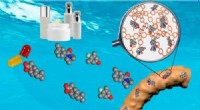 Opsugning af lægemidler og produkter til personlig pleje fra vandKredit:American Chemical Society Medicin, der udskilles i urinen eller dumpes i toilettet, kan ende i vandforsyningen, ligesom lotioner eller kosmetik, der vasker kroppen af og går ned i vasken
 -
 Forskere skaber ny form for dyrket kødKredit:Pixabay/CC0 Public Domain McMaster-forskere har udviklet en ny form for dyrket kød ved hjælp af en metode, der lover mere naturlig smag og tekstur end andre alternativer til traditionelt kø
 -
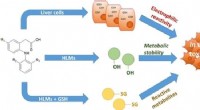 Subtile ændringer i kemisk struktur kan påvirke lægemiddeltoksicitetDerivater af lumiracoxib blev syntetiseret for at forstå forskellige kemiske gruppers bidrag til toksicitet. Forbindelserne blev testet i humane leverceller, og også med og uden tilstedeværelse af glu
 -
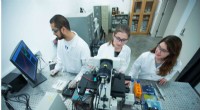 Kemiker studerer elektriske felter, mikrofluidik til forbedring af dialyteteknologiJoseph Banovetz, Beatrise Berzina og Robbyn Anand, venstre til højre, oprette en prototype -enhed til at teste separationsydelse i blodplasma. De bruger et fluorescensmikroskop til at følge to sporsto
- Hvordan bruger vi energien?
- Hvordan bliver plutoner synlige på jordoverfladen, hvis de dannes under jorden?
- Nukleolus og endoplasmatisk retikulum:Delte cellulære komponenter
- Beskriv de tre typer små partikler i et atom og forklar, hvordan de er arrangeret?
- Hvorfor vokser mange planter i en regnskov?
- Hvad er en skovbrand?